Most classrooms are designed with an imagined “average” learner in mind. The trouble is that this average rarely exists and for neurodivergent students, the gap between the standard classroom and the way they actually learn can be wide. Pedagogical designs and frameworks built for typically developing children are frequently unsuitable for neurodivergent learners, who often need targeted support to develop their social interaction abilities (Zhang et al., 2022). When the environment does not fit the learner, the costs mount quickly: disengagement, learning disadvantage, low proficiency in basic skills, and a heightened risk of early school leaving, risks to which neurodivergent students are especially exposed.
Virtual reality offers a way to close that gap. Not as a gadget or a novelty, but as a genuinely different kind of learning environment, one that can be shaped around the learner rather than the other way round.
An environment you can control
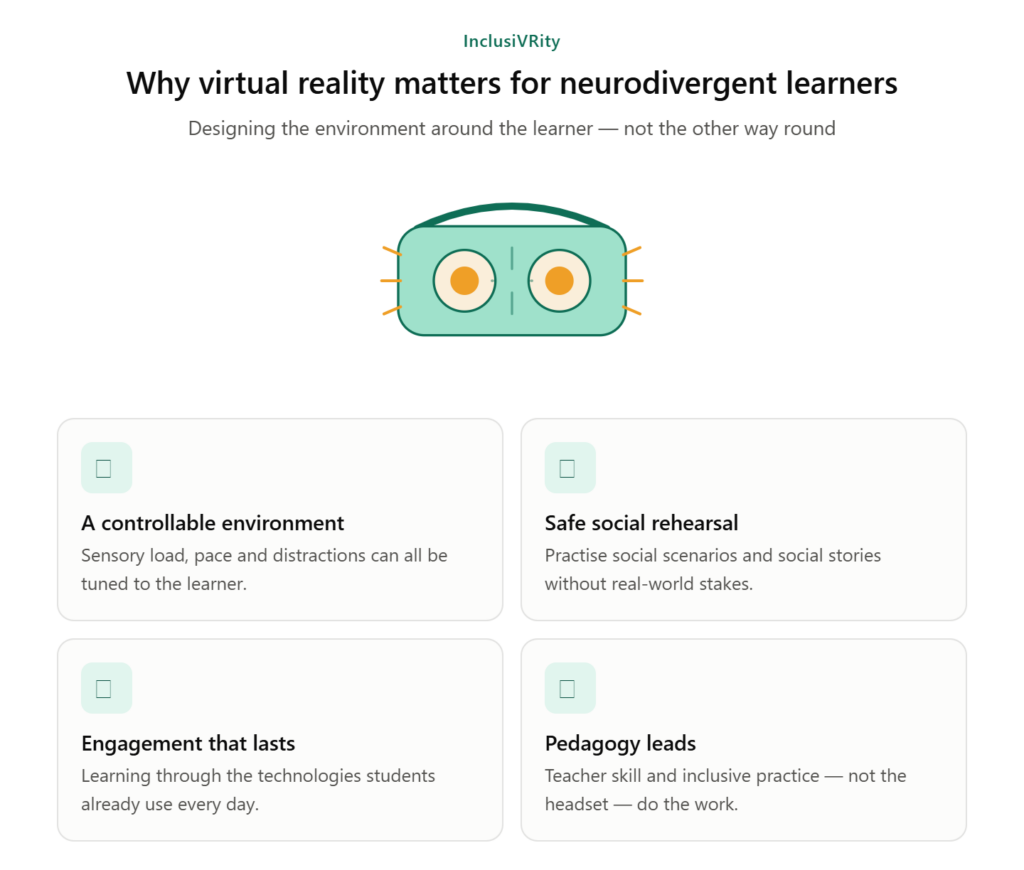
The single most important thing VR gives a neurodivergent learner is control over the environment. Traditional classrooms are noisy, unpredictable, and full of competing sensory demands. For a student with heightened sensitivity to sound, light, or movement, this is not a minor inconvenience as it can make learning inaccessible altogether.
A virtual environment can be tuned. Distractions can be removed, the pace can be set by the student, and the level of stimulation can be dialled up or down to match individual needs. What emerges is a calmer, more predictable space in which a learner can concentrate on the task itself rather than on managing everything around it. Research increasingly confirms that VR opens up a wide range of educational opportunities on exactly these grounds (European Agency for Special Needs and Inclusive Education, 2022).
A safe place to practise the hard things
Social interaction is one of the areas where many neurodivergent students most want support and one of the hardest to practise, because real social situations carry real stakes and real anxiety. VR changes the equation. It offers a real-life yet more “friendly” environment, making it well suited to intervention and skills development for learners who need to build confidence in how they relate to others (Zhang et al., 2022).
A student can rehearse a difficult conversation, navigate a busy corridor, or work through a social scenario as many times as they need, with no fear of judgement and no lasting consequences if it goes wrong. Paired with structured social stories, this turns anxiety-provoking situations into something that can be learned gradually, at a safe distance, before being carried into the world outside.
Meeting students where they already are
There is also a simpler reason VR works: it speaks the language young people already use. When learning happens through the technological tools students engage with in their everyday lives, rather than through traditional books alone, interest and motivation are far easier to sustain. Interaction with technology as a method of learning has been shown to help limit precisely the risks; learning disadvantage, disengagement, early school leaving that neurodivergent students face most acutely. Immersion is not a distraction from learning; for many of these students, it is what makes learning stick.
Technology is only half the story
None of this happens automatically. VR is a tool, not a solution in itself, and its value depends entirely on the pedagogy around it. Inclusive education asks teachers to develop competence in inclusive practice, to engage with research, and to use evidence to inform what they do in the classroom (European Agency for Special Needs and Inclusive Education, 2021). A headset with no pedagogical purpose is just an expensive novelty; the same headset in the hands of a confident, well-supported teacher becomes a way to reach students who were previously out of reach.
That is why the most promising work in this field treats teacher development and technology as a single package; building educators’ skills and confidence alongside the tools themselves.
Inclusion by design
Ultimately, the case for VR in neurodivergent education is a case about equity. For too long, inclusion has meant asking students to adapt to a system that was never designed for them. VR flips this around: it lets us design the learning environment around the learner, celebrating cognitive difference rather than treating it as a problem to be managed. Done well, it does not merely accommodate neurodivergent students as it gives them a genuine chance to thrive.